Proctoring Software for Assessment Platforms: The Shift to Network-Layer Integrity in 2026

Proctoring Software for Assessment Platforms: The Shift to Network-Layer Integrity in 2026

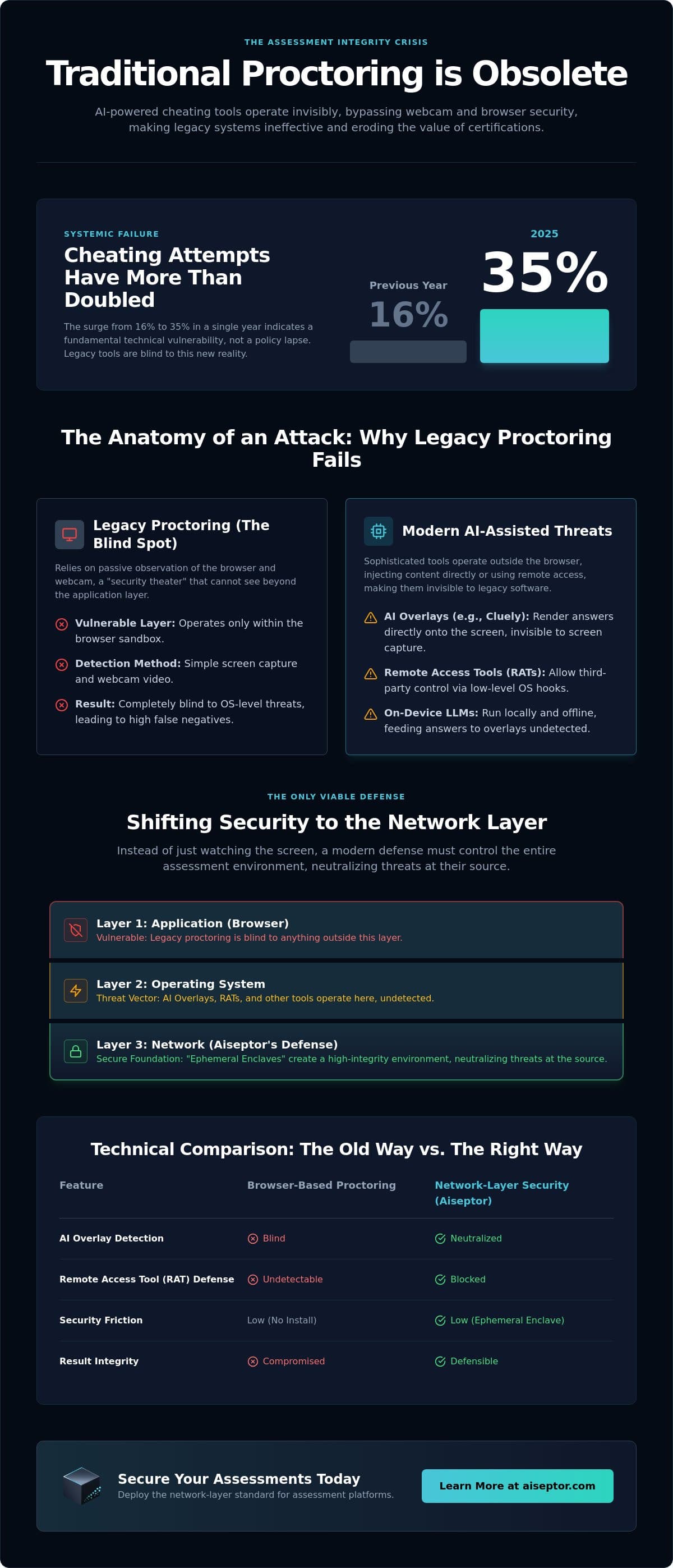
Traditional proctoring software for assessment platforms is currently suffering a total systemic failure. The webcam is no longer a reliable security instrument. In 2025, candidate cheating attempts surged to 35%, up from 16% the previous year. This isn't a simple lapse in policy. It's a fundamental technical vulnerability. Legacy suites are blind to the new reality of undetectable AI overlays like Cluely and remote-access tools that bypass the browser layer entirely.

You've likely seen the data. High rates of false negatives are eroding the value of your certifications. You need a defensible result that doesn't rely on invasive kernel-level drivers or high-friction candidate experiences. This article reveals why browser-based tools are obsolete and how network-layer security provides the only viable defense against modern AI-assisted threats. We'll outline the transition to API-first, deep-stack integrity that scales with your session volume while neutralizing the invisible tools your current proctoring software ignores.

Key Takeaways

  • Identify the technical blind spot in application-layer monitoring that allows AI overlays to bypass traditional screen capture and webcam observation.
  • Shift your defense strategy to the network layer, providing the only reliable barrier against OS-level cheating tools that modern proctoring software for assessment platforms currently ignores.
  • Deploy "Ephemeral Enclaves" to secure the assessment environment temporarily, ensuring high-integrity results without the friction of permanent software installations.
  • Leverage API-first integration to decouple delivery from security, allowing for a scalable and modular assessment stack that adapts to evolving AI threats.
  • Neutralize invisible AI-assisted cheating attempts at the source to eliminate false negatives and maintain the defensibility of high-stakes certification outcomes.

The 2026 Integrity Crisis: Why Assessment Platforms Are Under Siege

The assessment industry is currently facing a total collapse of trust. In 2025, cheating attempts on proctored exams spiked to 35%, more than doubling the previous year's rate of 16%. This isn't a minor trend; it's an existential threat to the validity of digital credentials. By mid-2026, "Invisible AI" tools have moved from experimental scripts to polished, mass-market overlays that operate entirely outside the reach of standard What is Online Proctoring? frameworks. Standard application-layer monitoring is no longer a viable defense. It's a legacy relic in a high-velocity threat environment.

If your security relies on what the browser can "see," you've already lost the battle. Modern proctoring software for assessment platforms must evolve from passive observation to an active security enclave. We're no longer just watching candidates; we're neutralizing unauthorized code execution at the network layer. This shift represents the only defensible barrier against the 88% of exams that now face active AI cheating risks. Without securing the network stack, the assessment environment remains an open door for sophisticated fraud.

The Failure of Traditional Lockdown Browsers

Lockdown browsers operate on a technical lie. They claim to secure the environment by restricting the application layer, but this ignores the fundamental reality of 2026. Persistent AI overlays like Cluely inject prompts directly into the candidate's field of view without ever touching the browser's Document Object Model (DOM). Remote-access tools (RATs) allow third parties to control the session via low-level OS hooks. Because these processes run at the kernel or OS level, browser APIs are technically incapable of detecting them. The "no-install" marketing hype has become a critical liability, leaving proctoring software for assessment platforms blind to persistent, invisible threats that bypass standard screen-sharing detection.

The Cost of Compromised Integrity

Integrity isn't a "nice to have" feature. It's the product itself. When certification bodies fail to block AI-assisted fraud, the market value of their credentials drops to zero. The financial impact is staggering. "Bad hires" resulting from technical interview fraud cost enterprises millions in lost productivity and internal security risks. In 2026, a "flagged" session isn't enough to maintain a competitive edge. You need a defensible result. If you can't prove the integrity of the network layer, your assessment platform is just a high-cost funnel for fraudulent talent. Brand erosion is permanent; technical debt in security is often fatal.

The Invisible Threat: Why Legacy Proctoring Software Fails Against AI Overlays

Legacy proctoring is a theater of observation. It relies on the camera lens and the browser window to maintain order. This is a fatal flaw. As detailed in the EDUCAUSE report on proctoring software prevalence, these tools are ubiquitous, yet their efficacy is crashing in the face of modern automation. They are built to catch human errors. They are not built to detect machine-level intrusions that occur beneath the application layer.

AI overlays represent a paradigm shift in cheating. They don't appear in screen recordings. They don't trigger browser events. They operate directly in the display buffer, rendering text and prompts over the exam interface. Standard proctoring software for assessment platforms cannot detect these tools because browser APIs are sandboxed by design. They are technically barred from seeing external OS processes. This creates a massive blind spot that candidates are exploiting with increasing frequency.

The threat extends to on-device Large Language Models (LLMs). Candidates now run local, quantized models that require no active internet connection. These models operate in the background, feeding answers to overlays in real-time. Furthermore, "second-device pivots" allow candidates to use network-connected hardware to process exam data externally. This bypasses all local lockdown measures. The security perimeter has moved from the room to the network stack.

Anatomy of an AI Overlay Attack

Virtual machines create a "nested" environment where the proctoring tool sees a clean, isolated OS while the actual exam runs inside a compromised container. Tools like Cluely AI render text that is invisible to standard screen-recording software because they operate at a higher priority in the display pipeline. An invisible overlay is a system-level process that intercepts the display buffer to render unauthorized content without modifying the application-layer data. This ensures the cheating remains invisible to any tool limited to the browser environment.

Beyond Behavioral Monitoring

Eye-tracking is a distraction. If an AI prompt is positioned near the exam question, the candidate's gaze remains within "normal" parameters. Audio monitoring is equally ineffective against silent, text-based AI assistants. The industry must move toward blocking the execution of unauthorized background processes. We must secure the device without requiring permanent, invasive kernel-level drivers. For organizations requiring a defensible barrier, Aiseptor for Assessment Platforms provides the necessary network-layer intervention to neutralize these invisible threats. Security is no longer about watching; it is about active environment control.

Network-Layer vs. Browser-Based Proctoring: A Technical Comparison

The browser is a sandbox designed for user safety, not administrative control. It's a fundamental architectural limitation. When you deploy proctoring software for assessment platforms that lives entirely in the application layer, you're building on a foundation of sand. Application-layer tools are restricted to the Document Object Model (DOM) and basic hardware permissions. They can't see what they don't own. In 2026, the battle for integrity has moved deeper into the stack, shifting from the browser to the network layer.

Security must be a binary state. Either the environment is secure, or it's compromised. Legacy solutions attempt to bridge this gap with constant video recording and behavioral AI. This creates massive data overhead and high rates of false positives. Network-layer security takes a different approach. It neutralizes threats at the transport level, blocking unauthorized data exfiltration and external AI calls before they reach the candidate's view. This is the "Ephemeral Enclave" concept. It's a temporary, high-integrity perimeter that exists only for the duration of the session. It leaves no trace on the candidate's machine and requires no permanent software footprint.

Comparing the Defense Layers

  • Browser-layer: Limited to the sandbox. It can detect tab switching but remains blind to OS-level overlays or virtual machines. It's a surface-level deterrent.
  • OS-layer: Monitors background processes and remote-access tools. It's more effective but often requires invasive, permanent installations that candidates resist.
  • Network-layer: The gold standard for 2026. It blocks the communication channels that AI tools require. By intercepting unauthorized traffic at the network stack, it neutralizes both on-device and cloud-based cheating assistants without needing to "watch" the user.

Privacy and Candidate Experience

Constant surveillance is a failed model. It drives candidate anxiety and creates a hostile assessment environment. High-stakes testing shouldn't feel like a police interrogation. By focusing on environment lockdown rather than behavioral flags, platforms can reduce "proctoring friction" significantly. 2026 candidates are tech-savvy. They understand the difference between a secure environment and invasive spying. They prefer ephemeral security enclaves because they're non-persistent. Once the exam ends, the security layer vanishes. There's no residual software, no privacy concerns about recorded video stored in the cloud, and no risk of "false positive" flags based on a candidate's eye movements or room lighting. Privacy by design means blocking the cheat, not recording the human.

Scalability is the final piece of the puzzle. Managing thousands of concurrent sessions requires a low-latency architecture. Network-layer interventions are computationally "light" compared to real-time video processing. This allows proctoring software for assessment platforms to scale across global session volumes without sacrificing security or performance. You get a defensible result with a fraction of the infrastructure cost.

Proctoring software for assessment platforms

Integrating Modern Security: API-First Deployment for Platforms

Legacy proctoring suites are monolithic anchors. They force vendor lock-in by bundling security with proprietary delivery engines. This architecture is obsolete. In 2026, the industry has pivoted toward modular assessment stacks. Decoupling the delivery layer from the security layer is the only way to maintain technical agility. You shouldn't be forced to use a specific assessment engine just to access high-integrity results. Modern proctoring software for assessment platforms must be platform-agnostic, operating as a silent, high-performance utility within your existing workflow.

The move toward API-first security allows platforms to embed a defense enclave directly into their session lifecycle. This isn't a "bolt-on" solution. It's a deep integration that uses REST APIs to manage the security state of every candidate device. By leveraging a modular approach, you eliminate the friction of legacy proctoring suites while gaining the ability to block modern AI threats at the network layer. Security is now a service, not a suite.

The Developer Experience

Implementing a network-layer defense shouldn't derail your development roadmap. The integration follows a clinical, three-step logic designed for speed and reliability:

  • Step 1: Authenticate the session. Your platform triggers a REST API call to initialize a unique security token for the candidate.
  • Step 2: Deploy the enclave. The ephemeral security client is delivered to the candidate device. It exists only for the duration of the exam. No permanent drivers. No system bloat.
  • Step 3: Monitor integrity signals. Your platform receives real-time telemetry. If an unauthorized AI overlay or a remote-access tool is detected at the OS layer, the signal is pushed back to your dashboard immediately.

The Economics of Proctoring in 2026

The "seat-based" tax is dead. Legacy vendors often demand annual minimums and rigid licenses that don't account for the volatile nature of assessment volumes. This model is a financial drain. In 2026, per-session pricing is the only model that scales for enterprise-level platforms. You pay for the integrity you consume. This eliminates the "long-term commitment" trap and aligns your security costs directly with your revenue or session volume.

The ROI of network-layer security is found in the reduction of manual review. Traditional proctoring software for assessment platforms generates thousands of behavioral flags that require human eyes to verify. This is expensive and slow. By blocking the execution of cheating tools at the source, you eliminate the need for post-exam forensics. You save on re-testing costs and protect your brand from the fallout of compromised credentials. For a technical deep-dive into deployment, explore Aiseptor for Assessment Platforms.

For high-stakes environments requiring total environment control, we are currently beta-testing the Aiseptor Secure Browser (beta). While the API-first model is ideal for seamless integration, a dedicated shell provides an additional layer of isolation for the most sensitive certifications. Choosing between a dedicated shell and a REST API deployment depends entirely on your specific risk profile and candidate experience goals.

Aiseptor: The Network-Layer Standard for Assessment Platforms

The era of passive observation has ended. Aiseptor provides the technical intervention required to secure the modern stack against invisible, machine-level fraud. We neutralize AI overlays at the network and OS layer, effectively blinding the cheating tools that render legacy proctoring software for assessment platforms useless. Our approach is surgical. We target the specific communication and display buffers used by LLM-assisted tools, neutralizing the threat before it reaches the candidate's field of view.

Technical teams require speed and precision. Our API-first architecture allows for deployment in minutes. You don't have to overhaul your delivery engine. You simply secure it. This modularity future-proofs your platform against the next generation of AI threats. As cheating tools evolve, your security enclave evolves with them. We provide the infrastructure for a defensible assessment result in a landscape where trust is a diminishing resource. The security perimeter has moved, and Aiseptor is the only solution built for the new boundary.

Aiseptor for Assessment Platforms

High-stakes certification and global technical hiring demand a seamless, professional candidate experience. Aiseptor for Assessment Platforms supports full custom branding and white-labeling. This ensures the security layer feels like a native part of your ecosystem, not a jarring third-party intrusion. Aiseptor is the only provider focused on blocking AI at the network layer. We provide the defensible barrier that enterprise hiring managers and certification bodies require to maintain the absolute value of their results. Whether you are conducting 100 or 100,000 sessions, the security remains persistent and invisible to the user.

Getting Started with Aiseptor

We've eliminated the barriers to entry that plague the industry. There are no annual minimums. You can start with a single session pilot to validate the technical efficacy of our network-layer intervention. This allows your team to experience the clinical precision of our proctoring software for assessment platforms without a long-term financial commitment. For organizations requiring a dedicated shell, we offer access to the Aiseptor Secure Browser (beta) for both Mac and Windows. This tool serves as a non-invasive alternative to traditional lockdown tools, securing the OS without permanent system modifications or invasive kernel-level drivers.

The Aiseptor Secure Browser (beta) intercepts unauthorized display requests and blocks background processes that attempt to scrape exam content. This level of control is essential for preventing the exfiltration of high-value question banks to external LLMs. The transition to network-layer integrity is not an option; it's a requirement for survival in 2026. Stop watching candidates. Start securing the environment. Secure your assessment platform with Aiseptor today.

Neutralizing the AI Threat: Securing Your Integrity Layer

The webcam is no longer a viable security instrument. Legacy proctoring software for assessment platforms is failing because it operates in the wrong layer of the technical stack. You cannot neutralize a system-level AI overlay from within a browser sandbox. The shift to network-layer integrity isn't a luxury. It's a technical requirement for any platform that values defensible results in 2026.

By adopting an API-first defense enclave, you decouple delivery from security and regain control over the candidate device environment. Aiseptor provides the only architecture designed to block invisible AI tools at the source while maintaining a low-friction candidate experience. It's time to move beyond behavioral flags and embrace clinical precision in environment lockdown. We focus on the blind spots that legacy vendors ignore.

Book a technical demo of Aiseptor’s network-layer security. Our solution offers a REST API for seamless platform integration and usage-based pricing with no long-term commitment. Stop recording behavior and start blocking threats at the OS layer. Your integrity standard starts here.

Frequently Asked Questions

How does network-layer proctoring differ from a standard lockdown browser?

Lockdown browsers are restricted to the browser sandbox. They can't see external OS processes. Network-layer proctoring operates at the transport level. It blocks unauthorized data exfiltration and external AI calls that happen outside the browser's reach. This creates a definitive security enclave rather than a simple tab-switcher detector. It's the only way to neutralize OS-level cheating tools effectively.

Can Aiseptor detect AI overlays like ChatGPT or Cluely?

Aiseptor identifies display buffer interceptions used by AI overlays. We don't rely on visual detection. We block the system-level processes that render unauthorized text on the screen. By neutralizing the communication between the AI model and the display pipeline, we ensure the cheating tool fails to function. This is a technical block, not just a behavioral flag that requires manual review.

Does the candidate need to install permanent software on their device?

Candidates don't need to install permanent software. Aiseptor uses an ephemeral security client that exists only for the session duration. It leaves no trace on the machine once the exam ends. This avoids the security risks and candidate resistance associated with permanent kernel-level drivers. It's a non-invasive intervention that prioritizes both device integrity and candidate privacy during the assessment.

Is Aiseptor compatible with mobile assessment platforms?

Aiseptor supports a wide range of platforms, including mobile OS environments. While high-stakes assessments often require desktop stability, our network-layer protocols are designed to secure any device connected to the assessment session. This ensures a consistent security posture across the entire platform. Our proctoring software for assessment platforms adapts to the specific hardware constraints of the candidate's device without sacrificing environment integrity.

How does the usage-based pricing model work for high-volume platforms?

Our pricing model is strictly usage-based. You pay per session rather than per seat. This eliminates the seat tax that forces platforms to pay for dormant licenses. It's a modular, scalable approach designed for high-volume enterprise platforms. You can scale from a single pilot to thousands of concurrent sessions without negotiating complex, long-term annual minimums or rigid, locked-in contracts.

Can Aiseptor block remote-access tools (RATs) used in technical interviews?

Aiseptor neutralizes remote-access tools by blocking low-level OS hooks. These tools allow third parties to control the keyboard or view the screen invisibly. Aiseptor's OS-layer monitoring identifies these unauthorized background processes and terminates their ability to interact with the assessment session. This is critical for maintaining the validity of technical interviews and high-stakes certifications where the identity of the test-taker is paramount.

What happens if a candidate tries to use a second device during the exam?

If a candidate attempts to use a second device to exfiltrate exam data, Aiseptor's network-layer security intervenes. We monitor for unauthorized local network traffic and external AI calls. The system blocks the communication channel used to send exam content to a secondary device or an external LLM. The platform receives an immediate integrity signal, allowing for real-time intervention before the session is compromised.

Is Aiseptor compliant with global privacy regulations like GDPR?

Aiseptor is built on privacy-by-design principles. We don't rely on invasive, constant video recording or biometric data collection. Instead, we focus on environment lockdown and process blocking. This reduction in sensitive data collection simplifies GDPR and global privacy compliance significantly. We provide a secure assessment environment that protects the integrity of the result without infringing on the personal privacy of the candidate.

Proctoring Software for Assessment Platforms: The Shift to Network-Layer Integrity in 2026 infographic