Preventing Technical Interview Cheating: A 2026 Security-First Case Study
By Aiseptor Team · July 6, 2026

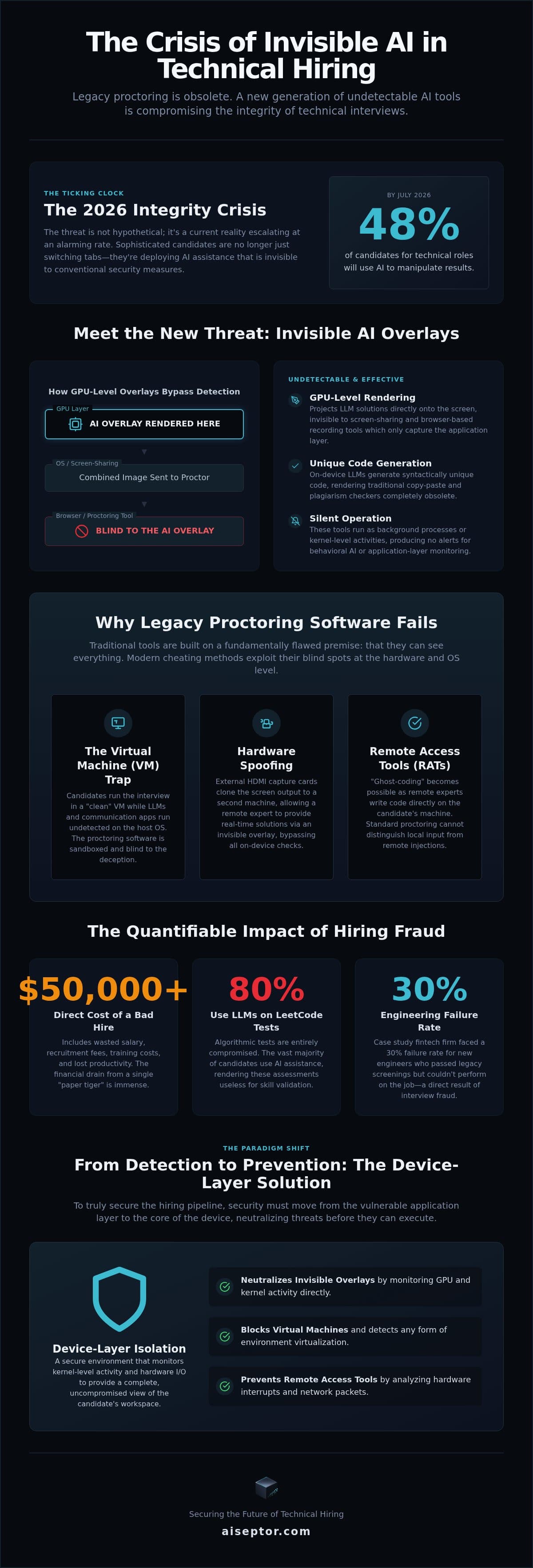
By July 2026, 48% of candidates for purely technical roles are using AI to manipulate their interview results. This is not a projected threat. It's a current crisis of integrity that renders legacy proctoring tools obsolete. Most existing solutions focus on browser monitoring, yet they remain blind to GPU-level overlays and invisible LLM assistants. You've likely felt the impact of hiring "paper tigers" who look perfect on a dashboard but can't code a single line without a prompt.
We agree that the current detection-based model is a losing game. To truly prevent technical interview cheating, your organization must shift toward device-layer isolation and clinical security precision. This case study demonstrates how to neutralize invisible AI overlays and remote assistance to secure your engineering talent pipeline once and for all. We'll preview a framework for a fraud-proof hiring process that identifies top-tier talent while maintaining zero false positives and high-speed scalability.
Key Takeaways
- Identify the mechanics of "Invisible AI Overlays" and why GPU-level rendering bypasses standard screen-sharing and browser-based detection.
- Examine the architectural failures of legacy proctoring tools and how to prevent technical interview cheating by moving security to the device layer.
- Analyze a real-world case study of a fintech firm that neutralized a 30% engineering failure rate using Aiseptor for Enterprise Hiring.
- Discover the "Application Layer Trap" and why traditional tab-monitoring is an obsolete defense against modern Virtual Machines (VMs).
- Learn how to scale a global talent pipeline with a "Complement vs. Replace" strategy that integrates deep security without increasing candidate friction.
The 2026 Crisis: Why Technical Interview Cheating is Now Invisible
By July 2026, the technical hiring landscape has reached a terminal point of vulnerability. The threat has evolved beyond simple browser-tab switching. Candidates now employ "Invisible AI Overlays" that utilize GPU-level rendering to project real-time LLM solutions directly onto their screens. These overlays are undetectable by standard screen-sharing protocols and legacy proctoring tools. Traditional copy-paste detection is officially obsolete. On-device LLMs generate unique, syntactically correct code that bypasses every existing plagiarism checker. This sophisticated evolution of academic dishonesty has migrated from the classroom to the enterprise, creating a "paper tiger" epidemic.
The stakes are quantifiable. Data from 2026 indicates that a single bad engineering hire costs an organization over $50,000 in direct losses. When 35% of candidates are actively using AI to misrepresent their skills, the integrity of your talent pipeline is non-existent. Organizations attempting to prevent technical interview cheating through behavioral observation alone are failing. They are fighting a 2026 war with 2018 infrastructure.
The Rise of Shadow AI in Coding Assessments
Shadow AI in recruitment fraud is the unauthorized deployment of generative models that operate beneath the detection perimeter of standard assessment software. Candidates use hidden LLM windows and secondary virtual desktops that browser-based tools cannot see. This shift is driven by a psychological pivot; many applicants view these tools as necessary survival mechanisms in what they perceive as broken, overly algorithmic hiring pipelines. They don't see it as fraud. They see it as a technical workaround.
Why 'LeetCode' Style Tests are Defenseless
Algorithmic "LeetCode" tests are now entirely compromised. Most LLMs have been trained on the exact problem sets used by top-of-funnel platforms. Research shows that 80% of candidates use LLMs during these tests, even when explicitly forbidden. Camera-based proctoring offers no defense against second-device pivots, such as tablets or phones positioned just outside the webcam's field of view. To prevent technical interview cheating, firms must move beyond the application layer. The solution requires device-level isolation that neutralizes the threat before the first line of code is written.
The Technical Blind Spots of Legacy Proctoring Software
Legacy proctoring software operates almost exclusively at the application layer. This is a fundamental security failure. Browsers are designed to sandbox processes for user privacy. They cannot inspect background applications or kernel-level activities. When you rely on browser-based tools to prevent technical interview cheating, you leave the door wide open to Virtual Machines (VMs). A candidate runs the interview inside a VM while the host OS runs an LLM or a communication app. The proctoring tool sees a clean environment. The reality is a multi-layered deception that traditional software is structurally incapable of detecting.
Hardware spoofing complicates the defense further. Candidates now use external HDMI capture cards to clone their screen output to a second machine. This second device is managed by a remote "expert" who provides real-time solutions via an invisible overlay. Behavioral AI, such as eye-tracking or typing pattern analysis, fails in these high-stakes scenarios. It frequently flags top-tier engineers for "suspicious" eye movements or atypical coding rhythms, leading to unacceptable false positive rates. Precision requires a deeper stack intervention. You can validate these security layers in your own environment to see the gap between behavioral observation and technical enforcement.
The Failure of Browser-Based Lockdown Tools
Lockdown browsers are easily bypassed because they rely on restricted web APIs. These APIs lack the permissions to see background processes or kernel-level overlays sitting above the browser's visibility. The "invisible screen" exploit allows candidates to share their display with a remote assistant without the proctoring app ever triggering an alert. The software is blind to any activity occurring outside its own sandboxed process.
Remote Access Tools (RATs) and Expert Assistance
Remote Access Tools (RATs) enable "ghost-coding," where an expert writes the code while the candidate mimics the typing. Standard proctoring cannot distinguish between local hardware interrupts and remote input injections. Traditional proctoring fails to monitor the network layer for incoming remote control protocols, creating a persistent vulnerability in the hiring stack. To prevent technical interview cheating, the defense must move from the browser to the system level, neutralizing remote inputs before they reach the assessment environment.

Case Study: Securing a Global Engineering Pipeline with Aiseptor
A mid-market fintech firm recently faced a 30% failure rate in new engineering hires. These candidates passed every technical assessment but lacked fundamental coding proficiency once onboarded. The firm's existing hiring stack was blind to the 2026 threat landscape. By deploying Aiseptor for Enterprise Hiring, they moved to prevent technical interview cheating at the infrastructure level. The intervention delivered a 95% reduction in suspicious activity. Hiring speed increased by 40% as the pipeline cleared of fraudulent noise.
Phase 1: Identifying the Integrity Gap
An initial audit uncovered that 15% of senior-level candidates were using unauthorized remote desktop tools. Legacy proctoring tools failed to detect these because they operated purely at the application layer. The firm also faced a friction problem. High-quality candidates frequently complained about invasive kernel-level drivers required by previous tools, leading to high drop-off rates. This created a skewed "integrity-adjusted" pass rate that favored cheaters over legitimate talent.
Phase 2: Deploying the Ephemeral Security Enclave
The firm integrated Aiseptor into their existing coding platform via REST API. This created an ephemeral security enclave for every interview session. The candidate experience was seamless. It secured the session without requiring permanent software installation on the candidate's device. The enclave neutralized invisible AI overlays at the network layer in real-time. It effectively blocked all external data injections while leaving no trace on the system after the session ended.
The Outcome: ROI of Fraud-Free Hiring
The ROI was quantifiable. By filtering out fraudulent senior-level hires, the firm saved significant capital in direct recruitment and turnover costs. Engineering managers reported a qualitative shift in their workflow. They stopped wasting engineering hours on "obvious" fraud cases and focused purely on technical evaluation. This transition to proctoring software for assessment platforms became a competitive advantage. You can deploy this network-layer security to protect your engineering pipeline today.
Future-Proofing Your Hiring: Scaling Integrity Without Friction
Retreating to in-person interviews is a strategic failure. It artificially constricts your talent pool to a small geographic radius, sacrificing global engineering excellence for a low-tech security blanket. To prevent technical interview cheating at scale, your organization must adopt a Zero-Trust assessment environment. This framework assumes the device layer is compromised until proven otherwise. It doesn't replace your behavioral interviewers; it complements them by providing a verified, sterile technical layer. Usage-based pricing ensures this security remains a functional utility, scaling alongside your recruitment cycles without the dead weight of fixed annual licenses.
The "Complement vs. Replace" logic is essential for senior-level hiring. You don't need to scrap your existing behavioral tools. Instead, you need to plug the technical holes they leave behind. Aiseptor for Enterprise Hiring sits beneath the application layer, providing the ground truth that video-based AI simply cannot reach. This creates a friction-free experience where the recruiter focuses on culture and the system handles the technical defense.
Security Without the 'Spyware' Feel
Top-tier engineers have a low tolerance for invasive surveillance. They prefer ephemeral enclaves over persistent background monitors that leave traces on their personal machines. Transparency is a trust-builder. When you communicate that integrity measures are session-specific and non-invasive, you attract higher-quality talent. Furthermore, network-layer data is objectively more reliable than video-based AI. It eliminates the false positives caused by a candidate looking away from the screen or having an atypical typing rhythm, ensuring that your prevent technical interview cheating strategy doesn't alienate legitimate experts.
Next Steps for Technical Recruitment Leaders
The transition to a secure pipeline is methodical. Start by auditing your current assessment stack. If your tools only monitor browser tabs, they are blind to on-device LLMs and GPU overlays. The path to resolution is fast. Integrating security via REST API takes less than a week, allowing you to harden your perimeter without disrupting your current workflow.
- Audit your stack for kernel-level and VM vulnerabilities.
- Shift from behavioral observation to network-layer enforcement.
- Deploy ephemeral security to respect candidate privacy.
Ready to secure your engineering pipeline? Try Aiseptor for free.
Secure the Perimeter: Implementing Device-Layer Integrity
The 2026 crisis isn't a future projection; it's your current operational reality. Legacy tools are structurally incapable of identifying GPU-level overlays or VM-masked assistants. To prevent technical interview cheating, your organization must move beyond behavioral observation and secure the device layer itself. We've established that ephemeral security enclaves provide the only clinical defense against modern fraud without alienating top-tier talent or compromising system privacy.
The choice is binary. You can continue to hire "paper tigers" based on compromised assessment data, or you can implement a zero-trust hiring stack that blocks 100% of invisible AI overlays. Aiseptor delivers this security without requiring invasive kernel-level drivers. Our usage-based pricing model means you only pay for the integrity you use, with no long-term commitment required. It's the precision tool designed for a high-stakes engineering market where technical truth is the only metric that matters.
Secure your engineering talent pipeline-Try Aiseptor for free. Reclaim your engineering hours and build a team rooted in verified technical reality. You have the tools to end recruitment fraud today.
Frequently Asked Questions
How do candidates bypass traditional browser-based proctoring?
Candidates utilize Virtual Machines (VMs) or secondary desktops that browser APIs are structurally incapable of inspecting. Browser-based tools are sandboxed for privacy and lack the permissions to see background processes or kernel-level events. This allows a candidate to run an LLM on the host OS while the interview appears "clean" within the browser. It's a fundamental architectural gap that legacy software cannot bridge.
Can Aiseptor detect invisible AI overlays like Cluely AI?
Yes, Aiseptor identifies and neutralizes GPU-rendered overlays by operating at the device and network layers. While legacy proctoring is blind to visual injections, our security stack monitors the underlying data flow and rendering processes. This proactive intervention makes invisible AI assistants non-functional during the session. It's a clinical defense that ensures the candidate's output is purely their own.
Is network-layer proctoring invasive for the candidate?
No, it's significantly less invasive than legacy tools that require persistent kernel-level drivers. Aiseptor focuses on session-specific data integrity and network isolation rather than broad system surveillance. It leaves no trace on the machine once the session terminates. This approach respects candidate privacy while maintaining the absolute security required to prevent technical interview cheating across global teams.
How does the REST API integration work for assessment platforms?
Integration occurs via a standard REST API that allows platforms to trigger security enclaves programmatically. Developers can harden their existing coding environments in less than a week without altering the core user experience. This low-friction deployment allows organizations to prevent technical interview cheating at the infrastructure level. It's an efficient way to upgrade legacy stacks without a total system rebuild.
What is an 'ephemeral security enclave' in the context of interviews?
An ephemeral security enclave is a temporary, isolated digital environment created specifically for the duration of the assessment. It acts as a secure "clean room" that blocks unauthorized inputs and external data streams in real-time. Once the interview ends, the enclave dissolves entirely. It ensures that the security measures exist only when needed and leave zero persistent footprint on the candidate's hardware.
Can Aiseptor prevent second-device cheating (e.g., using a phone)?
Aiseptor prevents second-device cheating by neutralizing the communication protocols required for data cloning or remote assistance. By securing the network layer, we block the ability to stream screen data to external capture cards or mobile devices. This isolation forces the candidate to operate within a closed loop. It effectively neutralizes the "second-screen" exploit that traditional webcam-based proctoring often misses.