How to Prevent Cheating in Online Certifications (2026)
Lockdown browsers cannot see the overlays, remote-access tools, and local models that defeat certification exams. Here is what actually closes the path, and what it cannot do.


When a certification can be bought from a proxy service for a few hundred dollars, the credential stops meaning anything to the employers who rely on it. That is the actual stakes of online exam security in 2026: not a single cheating candidate, but the market value of every credential a body has ever issued. And the tool most programs still trust to protect that value, the lockdown browser, cannot see the techniques that now defeat it.
The reason is structural. A lockdown browser is an application, and it can only enforce policy inside its own process. The tools candidates use today run outside that process: an overlay drawing to the screen, a remote-access session, a model running locally. This article explains why that gap exists, what closes it, and what an honest defense can and cannot promise. If you are responsible for a certification program, the goal here is to help you prevent cheating in online certifications with a clear view of the trade-offs, not a longer list of surveillance.
Key Takeaways
- A lockdown browser enforces policy inside one process. Overlays, remote-access tools, and local models all run outside it, which is why browser-level detection misses them by design.
- The most reliable defense is a default-deny network policy: only the assessment platform and explicitly allowed resources resolve, so a tool that needs to reach a model or an operator simply cannot.
- Detection targets techniques, not process names, because a renamed or recompiled tool defeats a name-based blocklist within the hour.
- The enclave is ephemeral: it deploys in about 30 seconds, needs no kernel driver, and removes itself at session end.
- No approach removes the need for identity verification, and a model already loaded on the device is caught by GPU evidence, not by network policy.
Table of Contents
Why the Browser Cannot See the Threat
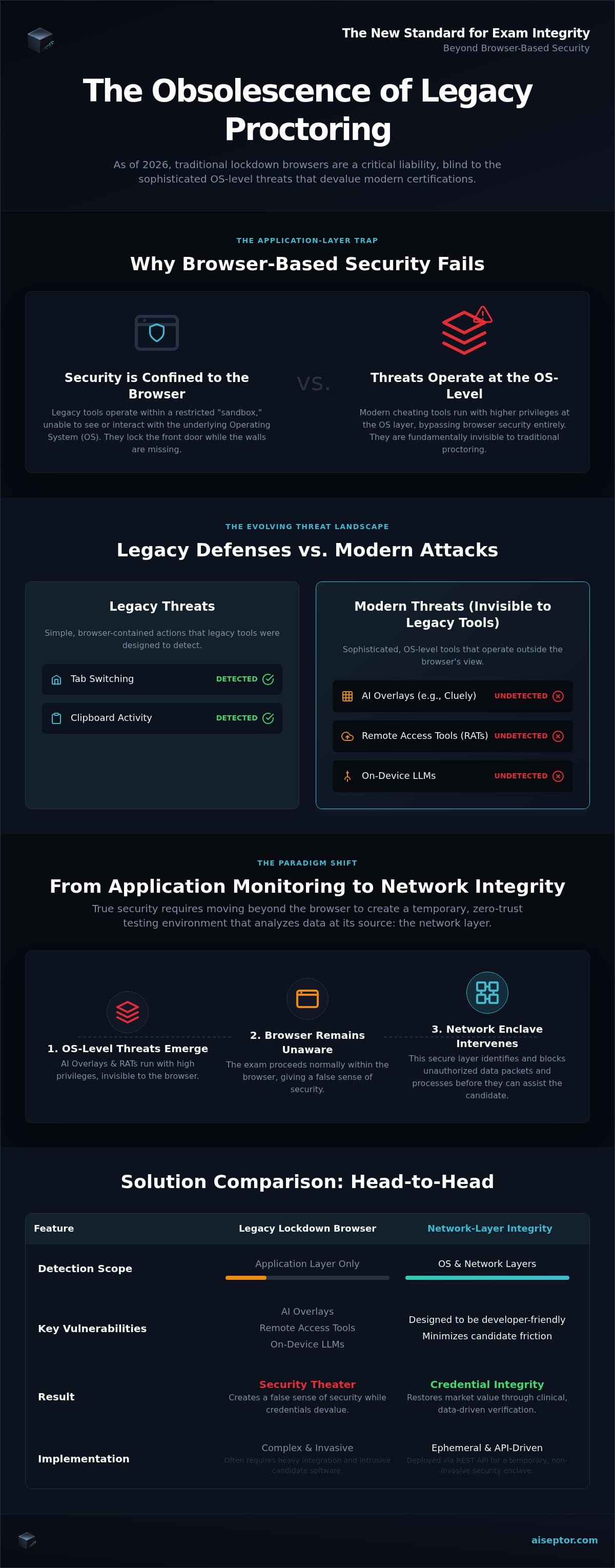
A lockdown browser can refuse a second tab, disable copy and paste, and notice when it loses focus. Every one of those controls operates inside its own application-layer process, and that is where its authority ends. It has no permission to inspect what else the operating system is running.
The tools that defeat it live in exactly that blind spot. An invisible overlay is a separate process drawing answers onto the screen. A remote-access session is a separate process holding a connection to an operator. A local model is a separate process consuming memory on the candidate's own machine. None of them need the exam browser's cooperation, and none of them appear in its view.
This is why the failure is quiet rather than loud. A tool operating outside the browser does not trigger a browser-level alert; it produces a clean session report. For a certification body, that is the dangerous part: the absence of a flag reads as a valid result, when it may only mean the browser could not see what happened. The scale is not hypothetical either. Talview's 2026 AI Threat Index puts 88% of online assessments at active risk from AI-assisted cheating, and CodeSignal reports fraud on proctored coding assessments rose from 16% to 35% in a single year.
The Three Techniques That Matter
Effective enforcement targets techniques, not names. A blocklist of known tool names is obsolete the moment someone recompiles a fork under a different name, which happens constantly. Each technique below has a property it cannot discard without ceasing to work, and that property is what gets caught.
Invisible Overlays
An overlay that stays hidden during screen sharing has to ask the operating system to exclude it from capture. On Windows that means setting the screen-capture-exclusion flag (WDA_EXCLUDEFROMCAPTURE); macOS has an equivalent window setting. The flag is the whole point of the tool, because an overlay visible in the recording is useless to the candidate. Checking for it catches the technique regardless of what the process is called. Background on the category is in the invisible AI overlay entry, and Cluely detection covers the best-known example.
Hosted AI and Remote Operators
A call to a hosted model, and a remote-access relay carrying a proxy tester, both depend on the same thing: reaching a destination over the network. Under a default-deny policy, only exam-approved destinations resolve, so the model call never completes and the operator can never reach the device. This one policy covers the largest share of attempts, because most cheating tools and every remote-proxy service are thin clients over a connection they no longer get to open.
On-Device Models
A model running locally is the honest edge case. Once loaded, it needs no outbound traffic, so network policy alone will not see it. What it cannot hide is the GPU memory it occupies: loading a model produces a memory footprint consistent with a resident model, and that is the signal that identifies it. Any claim that network enforcement by itself defeats local inference does not hold up, and a certification body should treat that claim as a warning sign in any vendor's pitch.
Closing the Path Instead of Chasing the Tool
Aiseptor runs each session inside an ephemeral enclave: a per-session environment that applies the default-deny policy above and inspects the device for the specific techniques described. It activates when the exam starts and removes itself completely when the session ends. There is no kernel driver, no persistent agent, and nothing left on the candidate's machine afterward. The mechanics are on network-layer exam security.
For proxy rings specifically, which combine an anti-detection virtual machine, a remote-control relay, and a paid expert test-taker, the enclave adds device fingerprinting on top of the network policy: virtualization artifacts fire a hard signal and the session is refused before the first question loads. The scale of that market, with pricing that runs from roughly $200 to around $10,000 per exam, is documented on our certification fraud page from our own review of publicly indexed proxy marketplaces.
The pricing model matters to certification bodies for a practical reason: it is usage-based and billed per session, with no seat minimums and no long-term licensing, so security cost tracks assessment volume rather than a forecast. Integration is a REST call, and most integrations are running in production in under a business day. The embedding model is covered on Aiseptor for assessment platforms.
What This Does Not Solve
Being specific about the limits is part of the argument. A program choosing a tool this year should know the edges before it signs, and any vendor unwilling to name them is asking for trust it has not earned.
- It is not identity verification. Confirming the right person is sitting the exam is a separate problem from confirming their environment is clean. You still need the first.
- No webcam, microphone, keystroke logging, or screen recording. The enclave collects network-access signals and device-activity metadata, and nothing else. That is a deliberate privacy choice, not a gap to be filled later.
- No kernel driver. That avoids the system-instability and privilege problems of deep OS access, at the cost of not seeing everything a driver would. The detection is built around techniques that do not require it.
- A locally loaded model is caught by GPU evidence, not network policy. Anyone promising network enforcement alone stops on-device inference is overselling.
Retention is 24 hours by default, the design is GDPR- and CCPA-compliant, and a SOC 2 Type II audit is in progress, targeted for Q3 2026. To prevent cheating in online certifications without turning the exam into surveillance, the honest position is that you move enforcement to the network and OS layer, close the path the modern tools depend on, and keep identity verification as its own separate control.
Frequently Asked Questions
Can modern proctoring detect AI overlays like ChatGPT or Cluely?
Browser-based proctoring generally cannot, because an overlay runs as a separate operating-system process outside the browser it is monitoring. Detection has to happen below the browser. Aiseptor checks for the screen-capture-exclusion flag every hiding overlay must set to stay out of the recording, and blocks the network path the overlay needs to reach a model, so it produces no answers regardless of what the process is named.
How do candidates bypass lockdown browsers in 2026?
The common routes are an invisible overlay running alongside the browser, a remote-access session that hands control to a proxy tester, a second device answering from off-screen, and a model running locally on the same machine. All four share one trait: they operate outside the browser's process, which is why a lockdown browser reports a clean session while any of them is active.
Is network-layer proctoring more invasive for candidates?
It is less invasive than video-based monitoring on most axes. There is no webcam requirement, no room scan, no keystroke logging, and no screen recording. The enclave collects network-access signals and device-activity metadata during the session, retains data for 24 hours by default, and leaves nothing on the device afterward. It is a narrower footprint than persistent surveillance, by design.
How do you stop remote access tools during a certification exam?
A remote-access tool needs a live connection between the candidate's device and the operator. Under a default-deny network policy, that relay never opens, so the operator cannot reach the machine and a local helper cannot phone home. This is enforcement by closing the path rather than by scanning a process list, which matters because a remote-access agent renamed to a generic system service defeats name-based scanning but not a blocked connection.
Does this replace identity verification?
No, and it is important to be clear about that. Confirming a clean testing environment and confirming the right person is present are two different jobs. Network- and OS-layer enforcement handles the environment; you still need an identity control alongside it. A vendor claiming one tool does both is worth a second look.
Frequently Asked Questions
Can modern proctoring detect AI overlays like ChatGPT or Cluely?
Browser-based proctoring generally cannot, because an overlay runs as a separate operating-system process outside the browser it is monitoring. Detection has to happen below the browser. Aiseptor checks for the screen-capture-exclusion flag every hiding overlay must set to stay out of the recording, and blocks the network path the overlay needs to reach a model, so it produces no answers regardless of what the process is named.
How do candidates bypass lockdown browsers in 2026?
The common routes are an invisible overlay running alongside the browser, a remote-access session that hands control to a proxy tester, a second device answering from off-screen, and a model running locally on the same machine. All four share one trait: they operate outside the browser's process, which is why a lockdown browser reports a clean session while any of them is active.
Is network-layer proctoring more invasive for candidates?
It is less invasive than video-based monitoring on most axes. There is no webcam requirement, no room scan, no keystroke logging, and no screen recording. The enclave collects network-access signals and device-activity metadata during the session, retains data for 24 hours by default, and leaves nothing on the device afterward. It is a narrower footprint than persistent surveillance, by design.
How do you stop remote access tools during a certification exam?
A remote-access tool needs a live connection between the candidate's device and the operator. Under a default-deny network policy, that relay never opens, so the operator cannot reach the machine and a local helper cannot phone home. This is enforcement by closing the path rather than by scanning a process list, which matters because a remote-access agent renamed to a generic system service defeats name-based scanning but not a blocked connection.
Does this replace identity verification?
No, and it is important to be clear about that. Confirming a clean testing environment and confirming the right person is present are two different jobs. Network- and OS-layer enforcement handles the environment; you still need an identity control alongside it. A vendor claiming one tool does both is worth a second look.