The Secure Browser for High-Stakes Testing: Beyond Legacy Lockdown Tools

By Aiseptor Team · July 4, 2026

The Secure Browser for High-Stakes Testing: Beyond Legacy Lockdown Tools

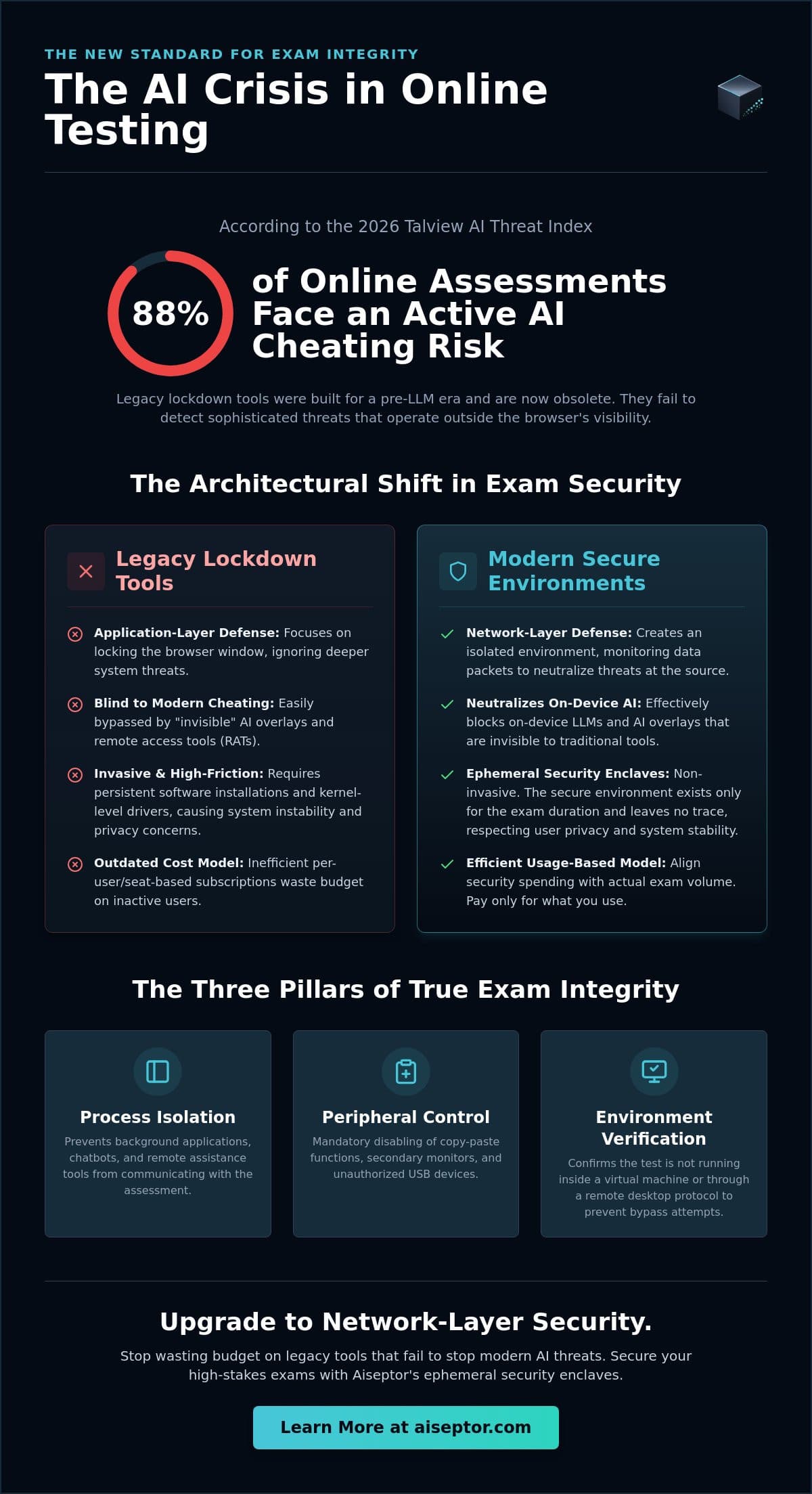
88% of online assessments now face an active AI cheating risk, according to the 2026 Talview AI Threat Index. Most institutions remain trapped in a cycle of deploying legacy tools designed for a pre-LLM era. If you're searching for a secure browser for high stakes testing, you've likely realized that traditional application-level blocks are no longer sufficient. You see the results in rising rates of invisible cheating and the high friction of invasive software installations that candidates despise. You're wasting budget on per-user subscriptions that fail to stop sophisticated AI overlays or remote-access tools.

Modern integrity requires a fundamental shift in the defensive stack. This article explores why traditional lockdown browsers fail against modern AI and how network-layer security creates a truly unhackable testing environment. We'll detail the technical transition from invasive desktop monitoring to ephemeral security enclaves. You'll discover how to neutralize threats at the infrastructure level while eliminating the deployment friction that plagues current assessment protocols.

Key Takeaways

  • Legacy lockdown tools are obsolete. Modern integrity requires environment virtualization that isolates the testing session from the host OS.
  • AI overlays and remote access tools bypass application-layer detection. You'll learn why traditional window-locking is no longer a viable security posture.
  • Network-layer defense is the new standard. Understand how monitoring data packets neutralizes on-device LLMs that bypass standard browsers.
  • Deploying a secure browser for high stakes testing involves more than a software install. It requires defining a specific security enclave for every session.
  • Transition to a usage-based cost model. Stop overpaying for seat-based subscriptions and align your security spend with actual exam volume.

What is a Secure Browser for High-Stakes Testing in 2026?

In 2026, a secure browser for high stakes testing is no longer just a restricted window. It's a specialized, isolated environment. This architecture separates the testing session from the underlying operating system. The goal is total containment. We've seen a rapid evolution from simple "lockdown" applications to complex environment virtualization. The industry is moving away from persistent software installations that clutter a candidate's machine. The new standard is the ephemeral security enclave. These enclaves exist only for the duration of the exam. Once the session ends, the security layer dissolves.

High-stakes exams in medical, legal, and technical fields demand this level of rigor. Tab-locking is a relic of the past. It's easily bypassed by modern hardware overlays and secondary devices. When the stakes involve professional licensure, the incentive for fraud is extreme. Integrity requires a defensive stack that operates deeper than the application layer. It must control the entire interaction between the user, the hardware, and the network. A secure browser for high stakes testing must neutralize threats before they reach the interface.

The Core Requirements of Exam Integrity

True integrity relies on three technical pillars. First, process isolation. The browser must prevent any background application from communicating with the assessment interface. This neutralizes hidden chatbots and remote assistance tools. Second, clipboard and peripheral control. Disabling copy-paste functions and secondary monitors is mandatory. Finally, environment verification. The system must confirm it isn't running inside a virtual machine or through a remote desktop protocol. These methods are common in modern Online proctoring bypass attempts. Without these controls, the assessment is vulnerable to systemic fraud.

Legacy Lockdown vs. Modern Secure Browsers

2024-era tools are failing. They were built to stop manual web searches, not 2026-era AI prompt injection. Modern cheating involves "invisible" AI overlays that sit on top of the browser window. Legacy tools can't see them. There's also a critical shift in how we achieve security. We're moving away from invasive kernel-level drivers. These drivers are notorious for causing system instability and raising privacy concerns. Modern solutions prioritize network-layer monitoring instead. This approach blocks on-device LLMs at the source without compromising the candidate's OS integrity. It balances rigorous security with the privacy expectations of a modern workforce. Security shouldn't mean system instability.

The AI Crisis: Why Traditional Lockdown Browsers Are Failing

Traditional lockdown tools are obsolete. They focus on the wrong battleground. While an administrator might believe their secure browser for high stakes testing is airtight because it locks the window, the reality is a massive security blind spot. According to the 2026 Talview AI Threat Index, 88% of online assessments now face active AI cheating risks. Most of these threats occur entirely outside the browser's visibility. The browser remains blind; the candidate continues to cheat.

Adversaries have moved beyond simple browser-based exploits. They now utilize a sophisticated arsenal of "invisible" tools that treat the lockdown browser as a minor inconvenience rather than a barrier. These tools operate at a deeper level of the system architecture, rendering application-layer monitoring useless. If your security strategy relies on detecting "unauthorized tabs," you've already lost the perimeter. The crisis is architectural. Legacy tools are trying to secure a house by locking the front door while the walls are being dismantled.

Invisible AI Overlays Explained

Shadow AI tools now operate at the OS or hardware level. They project text directly onto the screen as a transparent layer. Because these overlays don't hook into the browser's Document Object Model (DOM) or process list, they are invisible to standard detection methods. Screen-recording detection fails because the overlay isn't part of the captured video stream. If the software can't see the pixels, it can't block the prompt. It's a clinical failure of visibility. The candidate sees the answer; the proctoring tool sees a blank screen.

The Failure of Application-Layer Monitoring

Legacy tools rely on application-layer monitoring. They check for unauthorized background processes. Modern Remote Access Tools (RATs) bypass this by masquerading as essential system services or drivers. Locking the window is useless when the entire OS is compromised. Cheaters now use second-device pivots, using external hardware to bridge the gap between a "secure" environment and an LLM. These hardware-level bridges bypass software restrictions entirely. Organizations must audit their current defensive stack to identify these invisible vulnerabilities before the next exam cycle.

Traditional proctoring tools see a focused candidate and a locked screen. They don't see the data exfiltration happening via a kernel-level RAT. This is the "Blind Spot" problem. To secure a high-stakes environment, you must move beyond the interface. You need a defense that monitors the network layer to identify unauthorized data packets before they leave the machine. This requires a shift from reactive window-locking to proactive network isolation. Without a network-layer shield, your assessment data is effectively public domain.

The Aiseptor Difference: Network-Layer vs. Application-Layer Defense

Legacy solutions fail because they fight on the wrong tier of the stack. A standard secure browser for high stakes testing operates at the application layer. It monitors click behavior, restricts browser tabs, and watches the cursor. This is a surface-level defense. It ignores the underlying network traffic where modern cheating actually occurs. Aiseptor shifts the battleground from the interface to the infrastructure. By monitoring data packets in real-time, we identify unauthorized communication that legacy browsers simply cannot see. We don't just watch the candidate; we secure the data stream.

This architectural shift solves the "Blind Spot" problem. When an on-device LLM or an invisible AI overlay attempts to exfiltrate exam content, it generates specific network signatures. Application-layer tools are oblivious to these signatures because they occur outside the browser's DOM. Aiseptor intercepts these attempts at the source. We cut the cord between the exam environment and the AI. This is a definitive, binary intervention. Either the connection is authorized, or it's neutralized. There is no middle ground in high-stakes integrity.

Neutralizing Remote Access and LLMs

Remote Access Tools (RATs) are the primary weapon for sophisticated fraud. They allow a third party to view the screen and provide answers through hidden overlays. Aiseptor provides real-time blocking of these unauthorized remote desktop sessions by identifying the protocols they use to bypass the OS. We detect and neutralize invisible AI prompt injection by analyzing the outbound data requests before they reach an external LLM. Network-layer defense is a proactive shield against OS-level exploits. By operating at this deeper tier, we ensure that even if the operating system is compromised, the exam session remains an isolated enclave.

Non-Invasive Candidate Experience

Security shouldn't require total surveillance. Most legacy tools rely on kernel-level driver installations. These drivers are invasive, often triggering privacy alarms and causing system instability. They leave a permanent footprint on the candidate's machine. Aiseptor rejects this model. We avoid kernel-level hooks entirely, opting for a network-layer approach that respects candidate privacy while maintaining clinical precision. It's a cleaner, more professional interaction that reduces candidate anxiety.

Our "No Trace" policy is foundational to the secure browser for high stakes testing experience. The security enclave is ephemeral. It exists only for the duration of the assessment. Once the session ends, the software performs an automatic cleanup. No persistent files remain. No background processes continue to run. The candidate's device returns to its original state immediately. This low-friction deployment model ensures that security is a temporary, necessary intervention rather than a permanent intrusion.

Secure browser for high stakes testing

Implementing a Secure Browser Strategy for High-Stakes Certification

Deploying a secure browser for high stakes testing requires a transition from reactive monitoring to proactive infrastructure isolation. This isn't a passive software upgrade. It's a strategic overhaul of your integrity stack. To move beyond legacy failures, organizations must follow a methodical deployment framework that prioritizes clinical precision over broad surveillance. The goal is to create a temporary, unhackable environment that exists only for the duration of the assessment. Implementation follows five critical stages:

  • Step 1: Audit vulnerabilities. Identify the specific entry points for on-device LLMs and Remote Access Tools (RATs) within your current assessment stack.
  • Step 2: Define Enclave parameters. Determine the required security level for your specific exam, including peripheral blocking and network isolation rules.
  • Step 3: Integrate via REST API. Embed the security layer directly into your candidate workflow to ensure a seamless transition from registration to testing.
  • Step 4: Deploy cross-platform. Ensure the environment is compatible with both Mac and Windows machines to accommodate a diverse candidate base.
  • Step 5: Review per-session analytics. Use granular data to verify integrity. Focus on technical anomalies rather than subjective behavioral flags.

API Integration for Assessment Platforms

Assessment platforms require deep integration, not just a standalone application. The Aiseptor REST API allows developers to trigger ephemeral security sessions on demand. This ensures the security layer is active only when the exam is in progress. Organizations can scale from 10 to 10,000 sessions instantly without adding infrastructure overhead. By embedding this into enterprise hiring and certification portals, you maintain total control over the candidate experience. Security becomes an invisible, automated part of the platform architecture.

Securing the Global Talent Pipeline

Technical hiring and certification rely on a global talent pipeline. This pipeline is currently vulnerable to sophisticated fraud. Candidates in remote technical interviews often leverage AI assistance that traditional tools ignore. Aiseptor ensures consistency across diverse devices and network conditions. It neutralizes threats at the network layer, reducing the reliance on expensive human proctoring. This automation lowers costs while increasing the reliability of the results. Organizations ready to modernize their defensive stack should explore Aiseptor's integration options to secure their next assessment cycle.

A secure browser for high stakes testing must be as efficient as it is rigorous. By removing the need for persistent kernel-level installations, you reduce candidate friction and technical support tickets. The system performs an automatic cleanup after the session ends. This "No Trace" policy is essential for maintaining trust with professional candidates. You achieve maximum security with minimum intrusion. The result is a clinical, high-integrity environment that protects the value of your certifications.

Aiseptor: The Usage-Based Future of Exam Integrity

The legacy procurement model for exam security is dead. Long-term proctoring contracts and seat-based subscriptions represent a significant fiscal liability. They force institutions to pay for idle licenses and unutilized capacity. In 2026, this rigidity is unacceptable. Aiseptor introduces a usage-based model that aligns security costs directly with actual exam volume. This is the definitive shift from "Lockdown" to "Integrity." While legacy tools focus on restricting the user, Aiseptor focuses on verifying the environment. We provide a specialized enclave that exists only for the duration of the session.

The Aiseptor Secure Browser (beta) provides a clinical, network-hardened environment for both Mac and Windows. It's the only secure browser for high stakes testing designed to neutralize modern AI threats at the infrastructure level. As the winner of the 2026 Cornell Tech Startup Award, Aiseptor represents the cutting edge of network-layer defense. Our architecture ensures that security is a precise, temporary intervention. It's a non-invasive stack that leaves no trace on the candidate's device after the session ends. This ephemeral nature is the new standard for professional assessments.

Pricing Transparency and ROI

Usage-based pricing eliminates the waste inherent in traditional licensing. You pay only for the sessions you conduct. This model provides immediate ROI by removing the overhead of idle software. Contrast the cost of a single Aiseptor session with the catastrophic cost of a compromised credential. A leaked exam bank or a fraudulent certification can devalue an entire professional body. The financial and reputational fallout of a breach is systemic. Aiseptor provides a "No Commitment" advantage, allowing certification bodies to scale their security posture in lockstep with their growth. We offer a transparent, per-session cost structure that prioritizes your budget as much as your integrity.

Our commitment to clinical precision extends to data privacy. Aiseptor is GDPR and CCPA compliant, featuring a default data retention policy of 24 hours. We don't use webcams, microphones, or invasive screen recording. Instead, we monitor the network layer to block on-device LLMs and remote-access tools at the source. We're currently undergoing a SOC 2 Type II audit, targeted for completion in Q3 2026. This focus on objective, technical verification provides a more reliable security posture than subjective behavioral proctoring.

Get Started with Aiseptor

Modernizing your assessment stack is a matter of hours, not months. Enterprise hiring teams can deploy the Aiseptor Secure Browser (beta) to secure technical interviews and coding assessments immediately. The deployment is low-friction and high-impact. Our team, born from Cornell Tech, has identified the blind spots that legacy vendors ignore. We invite you to join the beta program and experience the difference of network-layer integrity. This is the end of invasive "lockdown" tools and the beginning of the ephemeral security enclave. Secure your high-stakes assessments with Aiseptor’s per-session integrity platform.

Neutralize the AI Threat at the Infrastructure Level

The transition from legacy lockdown tools to ephemeral integrity enclaves is no longer optional. Traditional application-layer defenses are defenseless against modern AI prompt injection and remote-access tools. To maintain the value of professional credentials, you must deploy a secure browser for high stakes testing that operates at the network layer. This shift ensures that invisible AI overlays are blocked before they can exfiltrate assessment data. It's a clinical, definitive solution to a systemic industry crisis.

Aiseptor provides this security without the instability of kernel-level drivers. Our platform offers a non-invasive, temporary environment that leaves no trace on candidate devices. You gain total visibility into the network stack while eliminating the waste of idle licenses through our usage-based pricing model. The era of invasive, ineffective surveillance is over. You can now align your security spend with actual exam volume while achieving unhackable integrity. Join the Aiseptor Secure Browser Beta and block AI cheating today. Your assessment integrity is the foundation of your organization's authority. Secure it now.

Frequently Asked Questions

Is a secure browser different from a lockdown browser?

Yes. Legacy lockdown browsers focus on the application layer by restricting tabs and windows. A secure browser for high stakes testing isolates the entire session at the network layer. It creates a virtualized security enclave rather than just locking the interface. This architecture neutralizes threats that exist outside the browser window, such as invisible overlays and background system processes.

Can a secure browser detect if I am using ChatGPT or an AI overlay?

Aiseptor identifies the specific network signatures generated by on-device LLMs and invisible overlays. Legacy tools fail because they only monitor the browser Document Object Model. Aiseptor neutralizes the data exfiltration required for AI prompt injection in real-time. By blocking the connection between the exam and the AI at the infrastructure level, we ensure the integrity of every response.

How does Aiseptor prevent remote access tools (RATs) from helping a candidate?

Aiseptor monitors the network stack for unauthorized remote desktop protocols. It identifies the specific data packets used by RATs to mirror screens or provide remote assistance. The system blocks these connections before a third party can interact with the exam environment. This intervention happens at the infrastructure level, rendering software-based bypasses ineffective against our defensive stack.

Does the Aiseptor Secure Browser require admin privileges or kernel-level drivers?

No. Aiseptor avoids invasive kernel-level drivers that compromise system stability and trigger privacy alarms. It operates as a non-persistent enclave that doesn't require permanent administrative hooks on the candidate's machine. This architecture reduces technical friction and deployment time. It ensures a clean, clinical experience that leaves no trace once the session ends.

Can candidates use the Aiseptor Secure Browser on both Mac and Windows?

Yes. The Aiseptor Secure Browser (beta) is fully compatible with both macOS and Windows environments. This cross-platform support is critical for securing a global talent pipeline. It ensures that organizations maintain a consistent security posture regardless of the candidate's hardware. The deployment remains low-friction across both operating systems, requiring no permanent software installation.

How much does a secure browser session cost for high-stakes testing?

Aiseptor utilizes a usage-based, per-session pricing model. This approach eliminates the budget waste found in traditional seat-based subscriptions or long-term proctoring contracts. Organizations pay only for the security they consume during active assessments. This model aligns security costs with actual exam volume, providing a transparent and scalable ROI for growing certification bodies and enterprise hiring teams.

What happens if a candidate’s internet connection drops during the secure session?

The secure enclave maintains local integrity protocols while attempting to re-establish the network link. Session data is protected through localized encryption to prevent tampering during the outage. Administrators receive immediate telemetry alerts if a disconnection occurs. This allows for a clinical review of the session's continuity and ensures that the security perimeter remains intact throughout the disruption.

Is the Aiseptor Secure Browser compatible with existing assessment platforms?

Yes. Aiseptor is architected for deep integration via REST API. It functions as a specialized security layer that embeds directly into existing enterprise hiring portals and certification platforms. This modular approach allows organizations to upgrade their defensive stack without replacing their current assessment software. It's a "complement vs. replace" logic that prioritizes rapid, high-stakes implementation.

The Secure Browser for High-Stakes Testing: Beyond Legacy Lockdown Tools infographic

We use essential cookies to run this site and, with your consent, first-party analytics cookies to understand how it's used. We don't use advertising or third-party tracking cookies. Learn more