Blocking Second Device Pivots: Neutralizing the Network-Layer Blind Spot in Exam Security

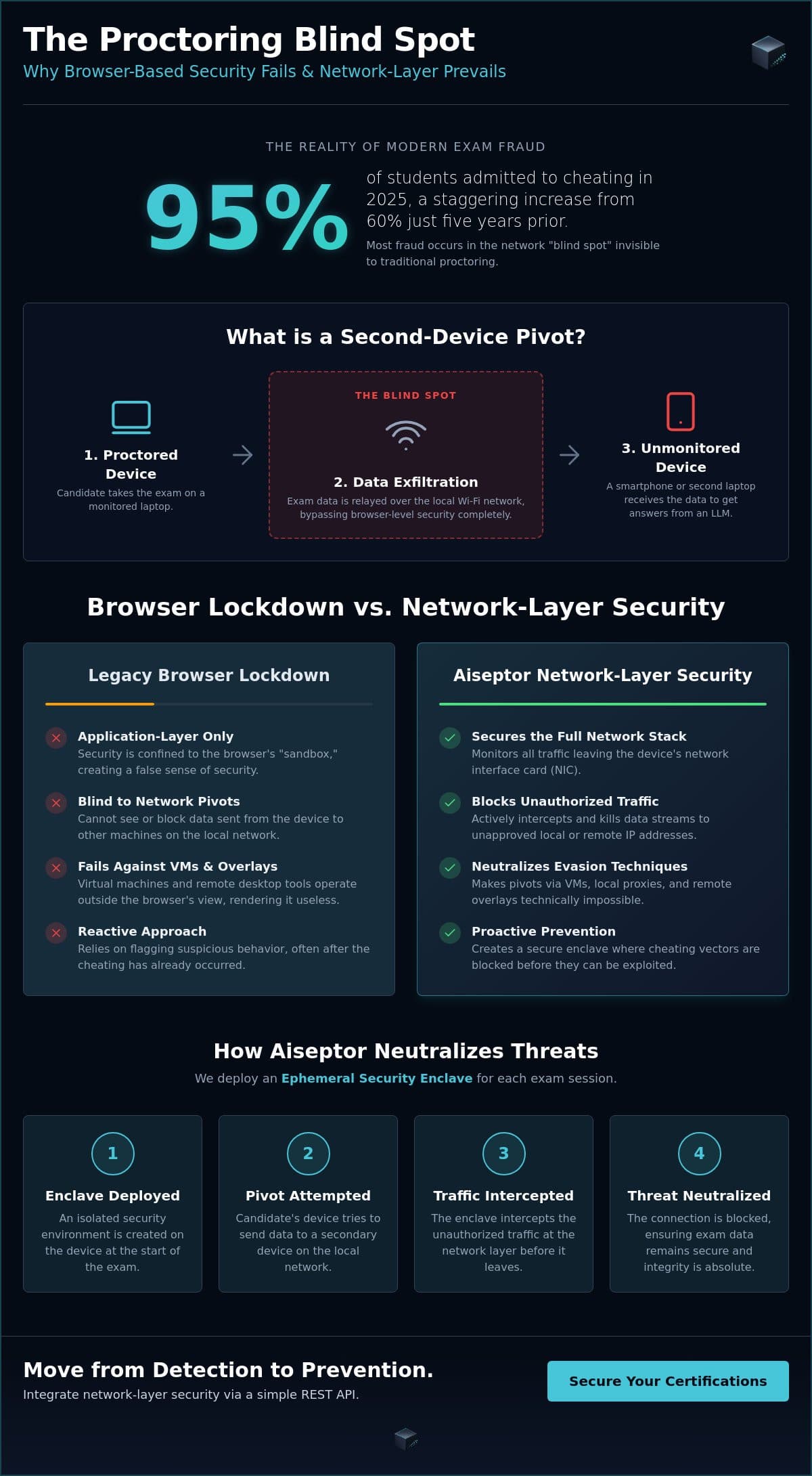
If your proctoring software only monitors the candidate's primary screen, you aren't running a secure exam. You're hosting an open-book test for anyone with a smartphone. Recent data reveals that 95% of students admitted to cheating in 2025, a staggering increase from 60% just five years ago. Most of this fraud occurs in the "blind spot" between the device and the router. To maintain the value of your certifications, you must block second device pivots at the network layer, where traditional application-layer security fails to reach.
You already know that standard lockdown browsers are no match for a candidate with a hidden phone and an LLM. It's a frustrating reality that dilutes the high-stakes value of your credentials. This article provides a definitive method to neutralize these threats by treating the local network as a hostile environment. You'll learn how second-device pivots bypass legacy tools and how to implement a network-layer solution that doesn't require invasive kernel-level drivers. We'll preview the shift from reactive detection to proactive prevention, ensuring your exam integrity remains absolute against AI-assisted fraud.
Key Takeaways
- Understand how candidates exploit the network-layer blind spot to relay exam data to unmonitored secondary devices.
- Learn how to block second device pivots by intercepting unauthorized traffic at the network layer before it leaves the device.
- Identify why legacy browser-based lockdowns fail to detect virtual machines and remote overlays that bypass application-level monitoring.
- Neutralize local network communications like mDNS and SSDP through the deployment of temporary, isolated security enclaves.
- Integrate network-layer protection directly into assessment platforms and enterprise hiring workflows via a low-friction REST API.
What is a Second Device Pivot in Exam Cheating?
Most proctoring solutions operate under a technical delusion. They assume that controlling the browser is equivalent to controlling the device. It's not. A second device pivot is a sophisticated exfiltration technique where a candidate uses their primary, proctored machine to relay exam data to an unmonitored secondary device. This occurs at the network or OS layer. It bypasses application-level monitoring entirely. With 95% of students admitting to cheating in 2025, the stakes have never been higher. By the time a legacy proctoring tool flags suspicious behavior, the data has already left the stack. To truly block second device pivots, security must move deeper than the browser window.
The threat is no longer just a student with a hidden phone. It's a candidate using a secondary laptop to run a Large Language Model (LLM) in real-time. The primary device acts as a silent transmitter. The secondary device acts as the intelligence hub. Because this happens outside the view of webcams and browser sandboxes, the assistance remains invisible to traditional human or AI proctors. It is a clinical failure of the current security architecture.
The Mechanics of Data Exfiltration
Candidates exploit several vectors to bridge the gap between secure and insecure environments. These methods are often undetectable by standard software because they operate outside the application's scope:
- Local network proxying: The primary device sends screen data or text to a secondary IP address on the same Wi-Fi network via background processes.
- Bluetooth-coupled pivots: Candidates use peripheral channels to bypass standard I/O monitoring, sending data to tablets or smartwatches.
- Hardware-level splitters: Physical HDMI or DisplayPort splitters clone the display signal to a second monitor or capture card. Software cannot detect these physical interruptions.
Why Traditional Proctoring is Blind
Legacy proctoring relies on application-layer limitations. Browsers only see what happens inside their own "sandbox." They are oblivious to traffic leaving the network interface card (NIC). This creates a false sense of security often called the "Air Gap" myth. Organizations assume that if a browser is locked, the candidate is isolated. In reality, modern Network security principles show that traffic can be routed around application-layer blocks with ease. If the security solution doesn't monitor the network stack, it isn't providing security; it's providing theater.
Standard lockdown browsers fail to account for network-layer traffic because they don't have the visibility required to block second device pivots at the source. A pivot is essentially a bridge between a secured application and an unsecured network. Without a network-layer intervention, that bridge remains open for every candidate with a smartphone and a secondary Wi-Fi connection.
Browser-Based Lockdown vs. Network-Layer Security
Legacy proctoring is built on a house of cards. It relies on the "Secure Browser" model. This approach assumes that restricting the application is equivalent to restricting the candidate. It's a false premise. Virtual machines and remote overlays exist entirely outside the browser's reach. They operate at the OS level. To effectively block second device pivots, security must descend into the network layer. This is where traffic is intercepted before it even leaves the Network Interface Card (NIC). Aiseptor replaces behavioral monitoring with technical neutralization. We don't just watch the user; we secure the stack.
The industry is at a crossroads. Legacy providers continue to focus on webcam AI and keystroke patterns. These are reactive measures. They attempt to catch a cheat in progress. Network-layer security is proactive. It creates an environment where the pivot is technically impossible. By monitoring the entire network stack, we identify and kill unauthorized data streams in real-time. This is the shift from "watching" to "securing."
The Vulnerability of the Application Layer
Application-layer tools are sandboxed. They only see what the browser allows them to see. Invisible AI overlays sit "above" the browser window but "below" the proctoring software's detection threshold. Screen-recording fails here. It captures the pixels the OS renders for the browser, not the secondary data streams being relayed to an external IP. Browser-based tools are fundamentally incapable of identifying network-level pivots because they don't have visibility into the local routing table. They are looking at the window while the data is exiting through the back door. This blind spot is the primary reason high-stakes certification value is currently being diluted.
Advantages of Network-Layer Interception
Network-layer security provides a clinical advantage. It allows for real-time detection of unauthorized outbound packets. By monitoring the stack, we identify the exact moment a device attempts to establish a peer-to-peer connection with a secondary smartphone or tablet. This level of scrutiny follows the rigorous standards found in the NIST Guide to IPsec VPNs, which outlines how to secure communications at the IP layer.
Unlike legacy solutions, this method neutralizes remote-access tools (RATs) that bypass standard process-killers. It doesn't require invasive kernel-level drivers that compromise system stability and user privacy. Instead, Aiseptor creates an ephemeral security enclave. It exists only for the duration of the session. It monitors the entire network stack to block second device pivots and then vanishes. This is the difference between a vigilant specialist and a failing generalist. If you need to secure high-stakes certifications, you need to move beyond the browser. You can explore how network-layer security integrates into your existing platform today.
How Aiseptor Neutralizes Second Device Pivots
Aiseptor does not rely on the passive observation of user behavior. It intervenes at the infrastructure level. To effectively block second device pivots, Aiseptor creates a temporary, isolated network environment on the candidate's device. This ephemeral enclave acts as a hard boundary. It systematically disables local network discovery protocols that candidates use to bridge devices. By blocking mDNS, SSDP, and local IP scanning, Aiseptor ensures the primary device cannot identify or communicate with unmonitored hardware on the same Wi-Fi. The discovery phase of the pivot is neutralized before it begins.
The Aiseptor Secure Browser (beta) extends this protection by functioning as an OS-layer shield. It detects on-device LLMs and shadow AI processes that run in the background. While traditional browsers allow these processes to coexist, Aiseptor identifies their presence through network signatures and memory patterns. It provides a clean room for the assessment. This is not a suggestion; it's a technical mandate. The security measure exists only when needed and leaves no trace afterward, maintaining the balance between high-stakes integrity and user privacy.
Intercepting the Pivot in Real-Time
Detection happens in milliseconds. Aiseptor identifies data patterns characteristic of screen-scraping or remote relaying at the NIC level. Most cheating attempts involve a specific handshake between the primary computer and a secondary smartphone. If our system detects this signature, it triggers an automated session termination. There is no manual review required; the threat is neutralized instantly. This is the only way to block second device pivots that exploit the local network stack. Aiseptor blocks the network bridge, not just the application.
Invisible Overlay Protection
Invisible overlays are the new frontier of fraud. These tools render assistance that never appears in a standard screenshot. Aiseptor identifies these overlays by monitoring the display stack for unauthorized rendering layers. This is critical for coding assessments and technical interviews where candidates use shadow AI to generate solutions in real-time. We ensure that the visual output the candidate sees is exactly what the proctoring system records. Shadow AI processes are identified and blocked from interacting with the exam interface. Integrity is maintained at the pixel level.

Implementation: Deploying Network-Layer Security via REST API
Security is only as effective as its deployment. Legacy proctoring suites fail because they are cumbersome; they require candidates to install invasive software that lingers long after the exam ends. Aiseptor is designed for assessment platforms and enterprise hiring teams that demand total integrity without the technical debt of permanent installations. By adopting an API-first approach, organizations can block second device pivots by embedding security directly into their existing testing workflows. This is a clinical intervention. It treats the candidate's device as a temporary secured node rather than a perpetually monitored asset.
The operational logic is simple. We provide a usage-based pricing model. This per-session structure is superior to the rigid, long-term contracts that define the legacy market. It ensures that security costs scale directly with your actual volume. You pay for the protection you use. No more. No less. This transparency allows for a low-friction integration that prioritizes both the candidate's privacy and the organization's bottom line. It's a security solution built for the modern infrastructure.
Integrating with Assessment Platforms
Modern platforms don't have time for complex hardware configurations. They use the Aiseptor REST API to launch ephemeral enclaves at the start of every session. This eliminates the need for candidates to install "creepy" monitoring software that requires elevated system permissions. By avoiding kernel-level drivers, Aiseptor significantly reduces technical support overhead. There are no system conflicts. There are no blue screens. The security layer exists only for the duration of the exam, providing the necessary visibility to block second device pivots before vanishing without a trace. It is the cleanest path to total integrity.
Securing Enterprise Technical Interviews
Bad hires are expensive. Industry data suggests the cost of a single junior engineer misstep ranges from $42,000 to $125,000. Engineering time is too valuable to waste on candidates using remote assistance or LLMs on secondary screens. Aiseptor ensures that senior-level coding tests and technical interviews remain untainted by second-device pivots. We filter out sophisticated fraud at the network layer, allowing your team to focus on genuine talent. You can build a high-trust talent pipeline by ensuring every line of code is written by the person on the screen. To secure your hiring process, start your free trial of five sessions today and experience the difference of network-layer integrity.
The Future of Exam Integrity: Ephemeral Security Enclaves
Legacy proctoring suites are a relic of a pre-AI era. They are bloated. They are invasive. They are ineffective. The industry is currently in a state of crisis, moving away from permanent software installations toward ephemeral, session-based security. These enclaves exist only for the duration of the exam. They create a temporary, hard boundary at the network layer. This is where the battle for integrity is won or lost. By adopting a posture of vigilant specialization, Aiseptor focuses on the infrastructure vulnerabilities that legacy tools ignore. The ability to block second device pivots is the new standard for certification bodies and high-stakes testing organizations. In an era of ubiquitous AI, network-layer defense is the only way to maintain the value of professional credentials.
Vigilant specialization beats the all-in-one legacy proctoring suites. Generalist tools try to monitor everything from eye movement to keystroke rhythm, yet they miss the data exfiltration happening at the NIC level. Aiseptor provides a clinical intervention. We secure the stack, neutralizing the network-layer blind spot that allows candidates to relay exam content to unmonitored hardware. This technical reality requires a shift in how we define exam security. Integrity is not about watching the user; it's about controlling the environment.
Why Non-Invasive Technology Wins
Candidate privacy is no longer a secondary concern. It is a baseline requirement. Global assessments face increasing scrutiny under GDPR and CCPA regulations. Aiseptor is compliant with these standards because our technology is non-invasive. We secure macOS and Windows environments without complex installs or kernel-level drivers. This cross-platform compatibility reduces the friction of high-stakes global assessments. Security that exists only for the duration of the exam respects the candidate's device while ensuring total integrity for the proctor. Non-invasive technology wins because it eliminates the technical and ethical conflicts of permanent monitoring.
Next Steps for Assessment Integrity
The time for reactive monitoring has passed. You must audit your current proctoring stack for network-layer vulnerabilities. If your current solution cannot identify local IP scanning or mDNS discovery, it cannot block second device pivots effectively. Transitioning to a usage-based, per-session security model allows your organization to scale protection without the burden of long-term, inflexible contracts. This shift prioritizes technical precision over administrative bloat. It ensures your certifications remain a verifiable proof of skill. You can secure your next assessment session with Aiseptor and move your security strategy from the application to the infrastructure.
Secure the Infrastructure to Protect Your Credentials
Legacy proctoring is failing. It's a technical reality that application-layer lockdowns cannot see the data exfiltration occurring at the network interface. To maintain the long-term value of your certifications, you must block second device pivots at the source. This requires a shift from reactive behavioral monitoring to proactive technical neutralization through ephemeral security enclaves. You don't have to choose between candidate privacy and exam security. You can have both.
Aiseptor provides this clinical advantage. Our solution is priced per session with no long-term commitment; you only pay for the protection you need. It blocks invisible AI overlays and prevents unauthorized local network handshakes without the friction of kernel-level drivers. Deployment is simple via a non-invasive REST API that avoids system instability. It's time to close the blind spot and reclaim the integrity of high-stakes assessments. You have identified the vulnerability; now you have the tool to neutralize it.
Neutralize AI cheating with Aiseptor's network-layer security and restore absolute trust to your testing environment.
Frequently Asked Questions
What is a second device pivot in the context of online exams?
A second device pivot is a data exfiltration technique where a candidate relays exam content from their proctored computer to an unmonitored secondary device. This bridge typically occurs at the network layer. It allows the candidate to use a smartphone or tablet to run LLMs or receive remote assistance. Legacy proctoring software is blind to this traffic because it happens outside the browser sandbox.
Can a lockdown browser detect a phone used for cheating?
No, standard lockdown browsers cannot detect physical hardware that isn't connected directly to the primary device. They are sandboxed applications with limited OS-level visibility. They lack the network-layer access required to identify a secondary device communicating over the local Wi-Fi. Aiseptor is necessary to block second device pivots by monitoring the network stack for these unauthorized handshakes.
How does network-layer proctoring differ from traditional proctoring?
Traditional proctoring relies on behavioral monitoring, such as webcam AI and keystroke tracking. Network-layer proctoring focuses on technical neutralization. It intercepts data at the NIC level before it leaves the device. While legacy tools try to catch a cheat in progress, network-layer security makes the pivot technically impossible by disabling the local communication channels that fraud requires.
Do I need to install a kernel driver to block second device pivots?
No, Aiseptor does not require kernel-level drivers to secure the environment. We avoid the system instability and security risks associated with invasive deep-system hooks. Our solution uses an ephemeral security enclave that operates at the network stack level. It provides total integrity without compromising the candidate's operating system or requiring permanent software installations that linger after the exam.
Is Aiseptor compatible with existing proctoring tools?
Yes, Aiseptor is built to function as a specialized security layer that complements your current stack. It fills the critical network blind spot that all-in-one legacy suites ignore. You can integrate our REST API into your existing assessment platform or hiring workflow. This allows you to block second device pivots without replacing your entire proctoring infrastructure or changing your candidate interface.
How does Aiseptor handle candidate privacy during network monitoring?
Privacy is maintained through ephemeral deployment and limited scope. The security enclave exists only for the duration of the active exam session. It doesn't log keystrokes, record audio, or access the webcam. Once the candidate finishes the test, the enclave removes itself entirely from the device. We prioritize infrastructure integrity over invasive personal monitoring, ensuring compliance with GDPR and CCPA standards.
Can Aiseptor block AI overlays like Cluely or ChatGPT?
Yes, Aiseptor identifies and neutralizes invisible AI overlays that render assistance directly onto the screen. These tools often bypass standard screen-capture methods by sitting in a different display layer. By monitoring the display stack and identifying shadow AI processes, Aiseptor detects these unauthorized rendering layers. It prevents these tools from interacting with the exam interface, ensuring the integrity of technical assessments.
What is the benefit of a usage-based pricing model for exam security?
Usage-based pricing eliminates the financial waste of rigid, long-term proctoring contracts. You pay only for the sessions you secure. This model allows certification bodies and enterprise hiring teams to scale their security costs directly with their candidate volume. It provides a transparent, low-friction path to high-stakes integrity without the burden of administrative bloat or expensive, unused license seats.